Launch an MVP Without a Developer: A Solo Founder Playbook
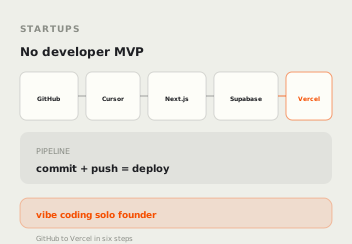
A non-technical solo founder can ship an MVP in 2026 with vibe coding : GitHub → AI coding agent → Next.js (or mobile tooling) → Supabase → Vercel, then commit…
BLOG
Product updates, engineering deep dives and notes from the field — written by people who actually ship the code.
Subscribe and get one new post about code, design and shipping — straight to your inbox. No filler, no growth hacks.
You're almost in. Check your inbox to confirm.
No spam. Unsubscribe anytime.
STARTUPS
Solo or co-founder for your MVP? A skills-map view from someone who has co-founded small products and contracted inside startups that won and lost.
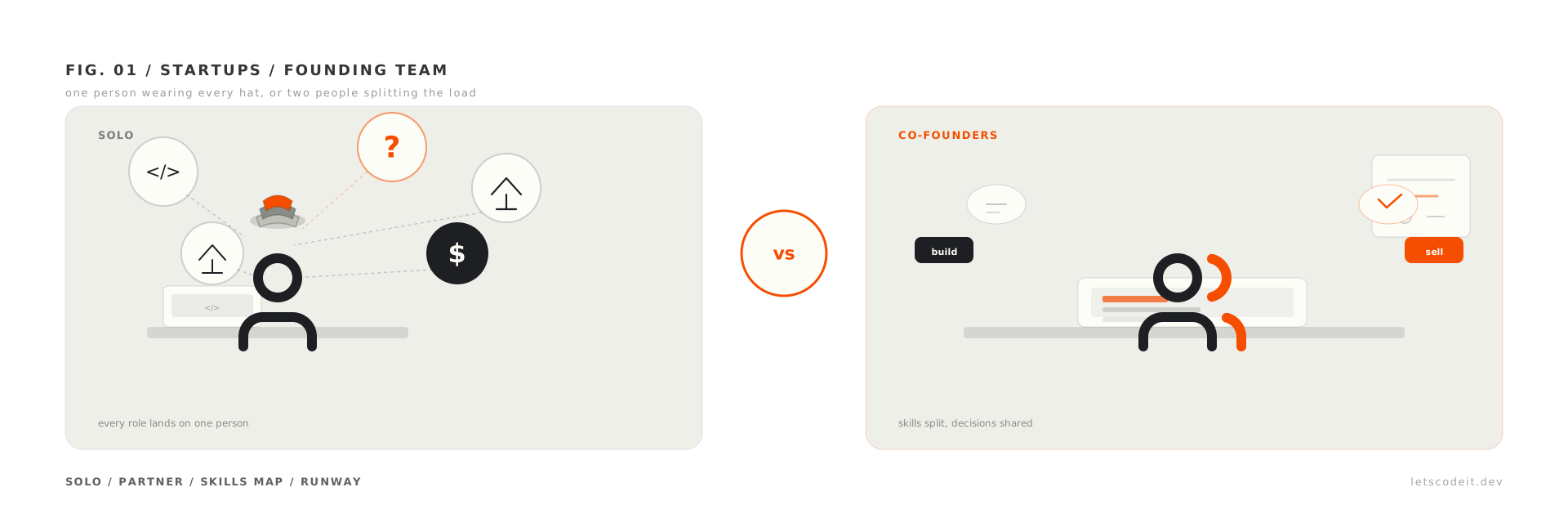
FIG. 01 ·Startups — June 20, 2026
Most MVPs do not need two founders on day one. They need five jobs covered: problem insight, product judgment, build, distribution, and enough runway discipline to stop gold-plating. Solo can work when one person owns the critical path and buys the rest with contractors and tools. The co-founder case I keep coming back to is harder to put in a skills matrix: someone in the room who helps you see the idea from outside, and who forces a line between blind faith and a business.
I have been on both sides of that decision. I co-founded small products where the cap table was small and the scope had to stay small too. I also contracted inside other people's startups, some that found traction and some that did not. This article is that outside view: patterns I saw as a partner with equity and as a hired engineer watching founders choose solo, split equity, or buy help.
Founders ask "solo or co-founder?" before they list what must get done in the next 90 days. That order puts the cap table ahead of the calendar.
Investor narratives overweight the two-founder team. Y Combinator treats co-founder matching as a core topic for good reason: complementary skills and shared commitment matter at scale. It is still a default, not a law of physics. I have watched solo founders ship credible MVPs with episodic help. I have also watched two-person teams spend a quarter aligning on a logo while a solo competitor ate their wedge.
At MVP stage, "doing everything yourself" really means covering five jobs. Some must stay founder-owned whether you are solo or not.
| Job | What it is | Solo-friendly? |
|---|---|---|
| Problem insight | You know who hurts and why | Founder-owned always |
| Product judgment | What to build, what to cut | Founder-owned; partner helps if you are pure engineering |
| Build | Code, design, content pipeline | Outsource slices; keep the core loop |
| Distribution | First users, SEO, community, sales | Hardest solo gap for technical founders |
| Runway discipline | Scope, burn, saying no | Solo can move faster; nobody stops your bad ideas either |
You aren't hiring a co-founder to "help." You are filling a gap that costs calendar weeks. If the gap is episodic, buy it. If it is daily, fix the gap before you fix equity.
As a contractor, the clearest signal was always the brief. Strong founders knew which of the five jobs they still owned. Weak ones wanted "a technical co-founder" when they really wanted a senior engineer on a discount, with equity instead of a rate card.
For a long time, the "ideal" founding pair was a technical partner plus a marketer. That made sense when build was slow, when shipping meant months of engineering before you could test anything, and when a non-technical founder could not get a credible MVP without someone on the cap table who lived in the repo.
LLMs and coding agents moved that line. The build job is still real. It is no longer always a reason to split equity on day one. A non-technical founder with clear product judgment can get surprisingly far solo: pick a free-tier coding agent, point it at a bounded feature, and ship scaffolding that used to require a junior dev week. I'm not saying the code is production-perfect on the first pass. I'm saying the old rule "you must find a technical co-founder before you start" is weaker than it was five years ago.
That does not mean solo is easy or that agents replace experience. Plenty of work still hurts without reps: debugging production, security basics, data modeling that survives growth, knowing when the MVP should stop growing. Distribution did not get easier because chatbots write functions. Why AI won't replace developers is about engineering judgment, not hype about solo unicorns.
Pieter Levels is the name people throw around here. He ships solo, publicly, across domains most founders would not touch alone. Treat him as an existence proof, not a template. He has years of pattern recognition, an audience, and a tolerance for rough edges that most first-time founders do not have on month one.
If you can't hire contractors yet, the bar goes up. You need either a very narrow wedge or genuinely broad experience across product and distribution, plus enough technical literacy to steer the agents without fooling yourself. Coding agents can lower the floor on build. They do not remove the five jobs. They change who can cover the build row today.
You can read up on domains you do not own. Surface knowledge arrives fast. Professional depth does not. Becoming strong in engineering, marketing, or ops takes years of doing the work, not a month of theory and agent prompts. If you only need shallow coverage, pay a contractor. If you need a lane owned daily, that is co-founder or hire territory, not YouTube depth.
Solo wins when the critical path fits one brain and you deliberately narrow scope. It also wins when you already have the experience and you know what you are doing across the jobs that matter for your wedge. In that case, partnership is optional, not missing.
AI magnifies whatever you bring in. Strong founders use agents to move faster through work they already understand: sharper iterations, less typing, more experiments per week. The same tools amplify weak lanes. They multiply mistakes at autocomplete speed. That asymmetry is why "solo plus agents" means different things for a ten-year engineer and for a first-time founder who just cleared a bug.
| Condition | Why it works |
|---|---|
| You know the lane | Deep reps in build, GTM, or product; agents accelerate, they do not teach |
| Critical path fits one person | Fewer alignment meetings; faster no |
| Episodic work is buyable | Design sprint, incorporation, one-off ads test |
| Scope is one wedge | One product surface, not marketplace + mobile + enterprise on day one |
| Speed beats consensus | Pre-PMF exploration; weekly pivots |
| You already have domain edge | Less pressure for a "business co-founder" on day zero |
Solo is not free. You pay in breadth, bus factor, and slower parallel work. On a product I co-founded, we stayed two people longer than we needed because we feared looking "small." We were small. Narrow scope would have been honest and faster.
From the contractor seat, the best solo clients were boring in a good way. One wedge, one deadline, a written list of what was out of scope. The painful ones had a solo founder plus three part-time "advisors" and no single owner for product calls.
The solo trap I worry about most is fixation. You live inside the idea every day. There is no one whose default job is to look at the product without your emotional stake in it. You can polish details for weeks and never ask whether the premise still deserves another month. A contractor will ship the brief. They rarely tell you to stop.
If you stay solo, you still need an outside mirror: customers on the calendar, a paid advisor, a written kill criterion. Without that, speed becomes drift.
As a contractor, I also saw the darker version of fixation: a solo founder absolutely sure of the direction, with a confidence nobody on the team could puncture. I would raise alternatives when I saw them. A good contractor does that. You are paid to flag risk, not to nod through a roadmap you think is wrong.
That helps on a sprint. It rarely saves a project over a year if the founder will not reconsider the premise. Small wrong calls compound. A weak architecture choice plus a shortcut in auth plus a feature built because it felt clever becomes a snowball you cannot refactor away on weekends. By the time the codebase screams, the founder has too much sunk cost to hear it.
The LLM era added a new flavor. I have watched non-technical founders vibe-code their way into that snowball faster. An agent fixes a bug. Another feature lands. The demo works in a screen recording. Each small win feels like evidence. The cognitive slide is familiar: "I guess I know how this works now." Prompt-and-ship replaces architecture, engineering discipline, and the boring parts of software methodology. Boundaries disappear. Tests are "later." Data models grow by accretion. Nobody names what happens when traffic is real.
Vibe coding can get you to a prototype. It does not replace vibe engineering: boundaries, tests, deployability, knowing when the repo is lying to you. That judgment is what Why AI won't replace developers is really about, not typing speed.
Solo makes both traps worse because there is no co-founder in the room to say the direction is wrong, and no engineer on the cap table who owns the cost of shortcuts.
That is why I still take the co-founder conversation seriously even when agents lower the build floor. Agents multiply output. They also multiply confident mistakes when the person steering them has no outside check on product direction or technical debt. Experience is the filter. Without it, AI mostly speeds up the snowball.
A co-founder does not need to show up with a perfect roadmap. Often neither of you knows the exact next steps or the final shape of the product. That is normal before product-market fit.
What changes with a real partner is still worth the equity conversation. First, you support each other when the work is ambiguous. That sounds soft until you have shipped through a bad month alone and realized nobody else remembers why you started.
Second, and this matters more to me, you eventually have to name what would prove the idea wrong. Two people in the same boat tend to ask a blunt question: what metric tells us to keep going versus stop? Paying users, retention, signed pilots, repeatable demos. The bar can be modest. It still has to exist. Without it, you are running on faith. With it, even a tiny team is acting like a business.
I watched solo founders hire strong engineers and drift for a year because nobody would say "kill it" out loud. I watched pairs with mediocre first drafts but clear thresholds ("if we do not have X by date Y, we pivot or shut down") argue honestly even when meetings ran long. The second group felt slower and often thought more clearly.
A co-founder beats contractors when the work is daily and contextual, tied to shared upside.
| Condition | Why a partner beats a vendor |
|---|---|
| Outside view on the idea | Someone pushes back on details you over-polish because the idea is yours |
| Continue / kill discipline | Shared pressure to define metrics before the runway defines them for you |
| Daily complementary work | You build every week; they sell or talk to users every week |
| Structural blind spot | You keep shipping features nobody asked for |
| Credibility gap | Enterprise, regulated markets, or some fundraising paths where "solo technical founder" closes doors |
| Real burnout risk | Sustained isolation on high-stakes calls, not a tired Tuesday |
| Multi-year bet | Shared vision, not a three-month SOW |
Pairings that often work: product or engineering plus distribution; domain expert plus builder; technical plus operational (finance, hiring later). The classic engineer-plus-marketer split still works when both people show up daily and trust each other's lane. It is no longer the only way to cover build plus GTM. Pairings that often fail: two engineers with no customer voice; two idea people with no shipper; a co-founder hired to avoid user conversations.
The co-founder relationships I saw work had already survived stress before incorporation: a failed launch, an angry customer week, a pivot. The ones that failed looked fine over coffee. They had never shipped anything hard together.
Skills on paper are not enough. When you launch with a co-founder, each of you has to understand the other's value and expertise. In the setup I trust, there are no absolute solo vetoes on day-to-day product calls. You discuss, evaluate, throw ideas around, and decide together.
If your partner disagrees or does not follow something, they owe you a clear explanation of their view. You owe them the same. The job is to make the reasoning legible: no sulking, no keeping score in silence, no "trust me" as a permanent substitute for words.
That bar is easy to write and hard to live. Sometimes you cannot unpack a decision. You just feel which move is right for the product right now, and the explanation arrives later than the commit. Sometimes your partner cannot meet you halfway even when you try. Sometimes the right move is to trust their expertise when yours stops at the keyboard. Both happen. Partnership is not a personality test you pass once.
On one product I co-founded, we hit that wall. My partner lost confidence in the direction and wanted to sell. I wanted to keep going. Fights were rare. We were still deciding from different pictures of the product. I could not always translate my conviction into clean arguments in the moment. He could not get comfortable staying in. We structured a buyout of his share. I continued solo.
The product earned solid revenue for several years after that. My calls after the split looked right in hindsight. I am still careful about that story. One winning stretch is not proof of founder genius. It might have been luck, timing, or a market wobble that favored what we had already built. I only trust my own judgment when a pattern repeats across products and cycles, not after a single outcome.
The takeaway for me was not "solo beat co-founder." It was that a partnership needs shared reasoning, and when the future splits, you need a clean exit before resentment becomes the roadmap.
The buyout story is not the whole picture. On another product I went the other way. I owned the technical side and deferred almost completely to my partner's read of the market and the product shape. Call it instinct or pattern recognition. He had a picture I could not get from inside the codebase.
The MVP took six months. Halfway through, I honestly did not believe we would ship something worthwhile. The stack worked. The demos looked fine. I still felt we were polishing a dead end. I kept building because that was the deal we made: his call on direction, my call on execution.
He was right. The product found its audience. I would have pivoted or shrunk scope months earlier if I had been solo, because my internal gauge stayed gray the whole time. That is the co-founder case I mean when I talk about seeing the idea from outside. Sometimes the outside view is not yours.
Same humility applies. One win where my partner saw further than I did is not proof that blind trust always works. It is proof that complementary expertise is real, and that solo doubt can cut both ways: you can kill a good idea too early when nobody else is in the room to hold the line.
Pulling those stories together, co-founders need a two-way skill. You have to justify your own vision clearly enough that your partner can engage with it. You also have to accept your partner's vision when they make the case, or when the decision clearly sits in their expertise. In most other setups I have seen, the partnership eventually fails: endless tug-of-war, silent veto, or one person checked out while the other kept building alone with equity still split.
| Dimension | Contractors | Co-founder |
|---|---|---|
| Commitment | Scoped deliverable | Shared upside and downside |
| Cost | Cash now | Equity later |
| Speed to start | Days | Months of trust and terms |
| Context | You brief; they leave | Product context accumulates |
| Best for | Landing page, design system, ads test | Daily sales loop, shared product direction |
If the work fits a statement of work, contract it. If the work is "figure out what we are building," that is founder work. Solo, hire, or co-founder can solve it. A cheap marketplace gig usually cannot.
I have been the contractor brought in to unblock a build while founders argued about vision. That can work for a sprint. It fails when founders treat you as a stand-in for a co-founder they never hired. I have also been the co-founder who wished we had contracted a design system instead of debating fonts for two weeks. The line is frequency and ownership, not pride.
After you choose solo, the next question is who to hire first and what the founder must still own. That is a separate essay on founder expertise and the first team. The solo decision comes first.
| Solo founder | Co-founder team | |
|---|---|---|
| Decision speed | Fast | Slower (alignment tax) |
| Skill coverage | Narrow plus bought help | Wider if complementary |
| Equity | Yours minus hires | Split early |
| Burnout risk | Higher isolation | Shared load if the relationship is healthy |
| Investor signal | Mixed | Often preferred |
| Best stage | Pre-PMF, bootstrap, narrow wedge | Proven split, daily complementary work |
| Failure mode | Idea fixation, no kill criteria, bus factor | Wrong partner, equity lock-in |
Run this today with a blank doc. No co-founder matching app required.
Copy this table if it helps:
| Task | Only me | Could contract | Partner daily |
|---|---|---|---|
| Example: ship landing page | x | ||
| Example: first ten sales calls | x |
Solo evangelism is as dumb as co-founder folklore. Still, the failures rhyme.
Regulated industries sometimes need role separation from day one. Hardware plus software plus supply chain rarely fits one calendar. If you will not do distribution and will not hire it either, solo is a trap. Two people already building together with proven trust and a clean split of labor should not break up because a thread said solo is virtuous.
Products I co-founded that stalled usually had a distribution gap we kept calling a "later problem." Startups I contracted for that died often had the opposite problem: two founders with overlapping skills and no one who would talk to users. Successful ones, solo or paired, had the same boring habit: someone owned customer reality every week.
Agents and AI IDEs can shrink the build calendar. They can also accelerate vibe-coding debt when nobody owns architecture or pushback on direction. They do not sell your product or name your stop rule. I have seen founders ship faster with coding agents and still miss PMF because nobody owned distribution. The tool changed who can cover the build row. It did not change the five jobs.
Yes for many software MVPs if scope stays narrow and you contract episodic gaps like design or legal. Coding agents also make solo build more realistic for non-technical founders than it was a few years ago, as long as product judgment and distribution still have an owner. No for businesses that need parallel full-time functions from day one, such as hardware supply chain plus firmware plus sales in the same quarter. I have seen both outcomes up close.
Some do. Many prefer teams. Bootstrap traction, revenue, or a clear credibility story often moves the conversation more than whether you started alone. Treat "investors hate solo founders" as folklore until you talk to the investors you actually want.
Fixation on the idea, or on a direction you are sure about when nobody else can move you. Non-technical solo founders who vibe-code can add a technical snowball on top: each bug fix feels like proof you understand the stack. Bus factor and distribution gaps hurt too. The usual failure is not "could not ship." It is "shipped the wrong thing nobody wanted" for twelve months because nobody named a stop rule. That showed up on solo projects I co-founded and on solo founders I supported as a contractor.
When a skill gap blocks progress for months, trust already exists, and equity can match contribution. Also when you want a real peer for product judgment, not only execution help. Avoid the search if you are ducking customer calls or want a friend in the same Slack because building feels lonely.
For defined deliverables with a clear SOW, yes. For daily product direction, shared commitment, and accumulated context over years, no. Know which bucket you are buying. I have been hired for the wrong bucket more than once.
Yes in common usage. "Solo" usually emphasizes no co-founder at founding. "Single founder" shows up in legal and investor paperwork. Same person, different emphasis.
This article argues both sides because both are real. If you ask what I would pick now, knowing what I know from co-founding, contracting, buyouts, and the vibe-coding wave: I would still choose partnership.
I care about technical excellence and product development over the long arc. Agents can help you start. They do not replace someone who lives in the craft next to you. The old pairing of an experienced engineer plus an experienced marketer still works for me. That is the split I would look for again: deep build on one side, deep distribution and customer read on the other, with the two-way skill from earlier in this post.
Solo is more possible than it was. I would not treat it as my default if the goal is a product I want to refine for years and I still have gaps in the daily lanes. If I already owned build and distribution deeply and knew exactly what to ship next, I would go solo and let agents amplify that. I would rather split equity with the right partner than stack superficial skills and call it coverage.
Pick solo or co-founder from gaps, not from loneliness or investor cosplay. List the five jobs, run the ten-task audit, and name a continue-or-stop metric even if the roadmap is still fuzzy. If you choose a co-founder, plan for both directions: explain your calls, and accept theirs when the reasoning or the expertise is theirs. Most partnerships I watched fail missed one of those two. Shallow knowledge in a lane you do not own is a tax: pay a contractor for a sprint, or partner for the daily work. Wrong co-founder is expensive. Solo with no outside view is expensive too. A business needs a line between faith and evidence.
A non-technical solo founder can ship an MVP in 2026 with vibe coding : GitHub → AI coding agent → Next.js (or mobile tooling) → Supabase → Vercel, then commit…
Subscribe and get one new post about code, design and shipping — straight to your inbox. No filler, no growth hacks.
You're almost in. Check your inbox to confirm.
No spam. Unsubscribe anytime.
No comments yet. Be the first to share your thoughts.
Comments