
GEO for developers: what gets cited by ChatGPT and Perplexity
GEO (generative engine optimization) is how you structure and publish content so AI chatbots and answer engines quote your pages when someone asks a question.…
BLOG
Product updates, engineering deep dives and notes from the field — written by people who actually ship the code.
Subscribe and get one new post about code, design and shipping — straight to your inbox. No filler, no growth hacks.
You're almost in. Check your inbox to confirm.
No spam. Unsubscribe anytime.
AI FOUNDATIONS
LLM APIs charge by tokens, not words. See how language and tokenizer choice change cost-from Latin scripts to Amharic-and what a real system prompt costs at scale.
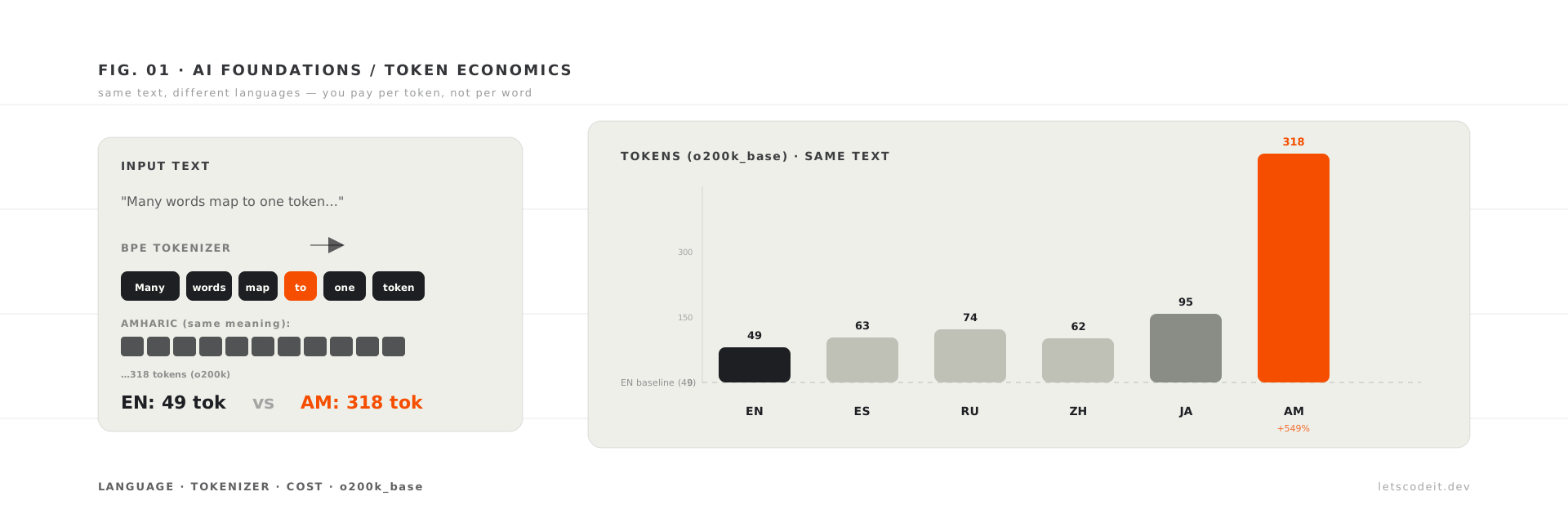
FIG. 01 ·AI Foundations — May 28, 2026
When you send a message to an LLM, you are not paying for characters or words. You pay for tokens.
A token is the unit the model splits text into before processing: every major model API bills on tokens. For an individual user, the language of a request changes what you spend-or how fast you burn through limits on a subscription. For a company handling millions of requests per day, the difference can be hundreds of thousands of dollars per year.
Many people hit token limits when using LLM agents heavily. I wanted to see how much the language of your prompts actually affects token count.
Modern language models use Byte Pair Encoding (BPE): text is split into bytes first, then the most frequent byte pairs are merged into a single token-repeated until the vocabulary reaches the target size.
The tokenizer vocabulary is trained on a text corpus. The more often a word or syllable appears in training data, the more likely it becomes its own token.
The rule is simple: a tokenizer is only as efficient as the exposure your language got during training.
Note that proprietary models use their own closed tokenizers; the exact vocabulary is not published. The numbers in this article come from public tokenization tools and reflect real behavior, but internal tokenizer details can change between model versions without a public announcement.
Most large language models were trained primarily on English text. That means the tokenizer vocabulary is dense with English words and morphemes-they often encode in a single token. Other languages look different.
When you send text in an underrepresented language, whole words are split into many small tokens. That means:
More detail with examples below.
An important nuance: models are not only more expensive on non-Latin text-they also perform worse. Most internal representations and reasoning patterns were shaped on English. Working in another language spends part of the model’s “intellectual budget” on translation rather than on the task itself.
Time to run some tests.
All data below uses OpenAI’s current o200k_base tokenizer (GPT-4o, GPT-4o mini, o1, o3, GPT-4.5, GPT-5.x). The legacy cl100k_base tokenizer (GPT-4, GPT-4 Turbo, GPT-3.5 Turbo) is not included in the comparison tables.
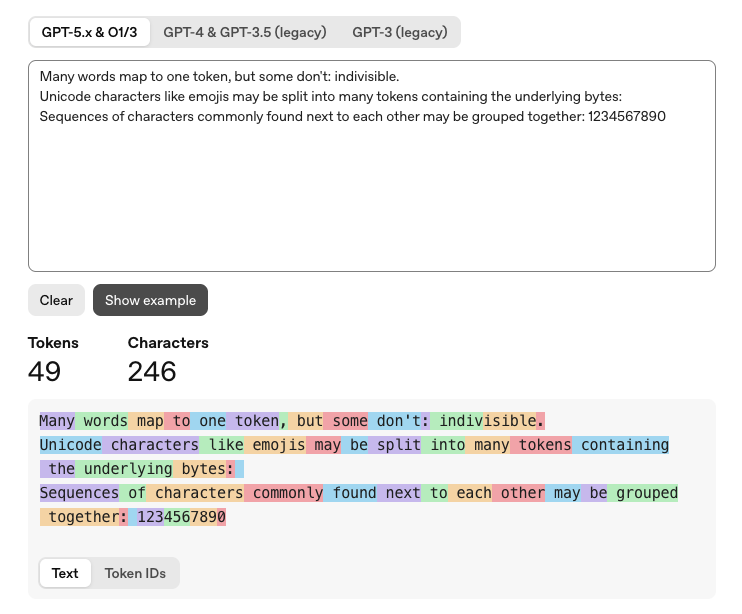
We start from English source text: "Many words map to one token, but some don't: indivisible. Unicode characters like emojis may be split into many tokens containing the underlying bytes. Sequences of characters commonly found next to each other may be grouped together: 1234567890", the example used in the tokenizer at platform.openai.com/tokenizer (official, OpenAI only). We translate it into other languages with an LLM and compare token counts.
Group 1 - Basic Latin (overhead up to +31%)
| Language | Characters | o200k | Δ vs EN |
|---|---|---|---|
| English (EN) | 246 | 49 | - |
| Spanish (ES) | 293 | 63 | +14 (+29%) |
| French (FR) | 300 | 62 | +13 (+27%) |
| German (DE) | 281 | 64 | +15 (+31%) |
All three are very close to English-the tokenizer covers Latin script well. Small overhead comes from accented characters (ü, ö, ä, é, ñ, etc.) and slightly longer translations. German is a bit pricier because of long compounds (Zeichenfolgen, zugrunde) that do not fit in the vocabulary as whole tokens.
Group 2 - Cyrillic and CJK (overhead +27–96%)
| Language | Characters | o200k | Δ vs EN |
|---|---|---|---|
| Russian (RU) | 275 | 74 | +25 (+51%) |
| Ukrainian (UK) | 266 | 88 | +39 (+80%) |
| Belarusian (BE) | 279 | 96 | +47 (+96%) |
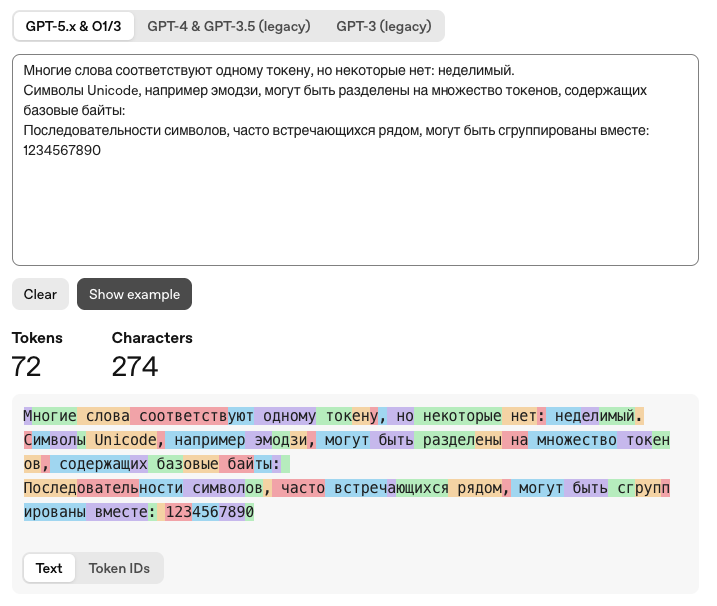
Belarusian vs Ukrainian vs Russian - 96 / 88 / 74 tokens on the same alphabet. The gap reflects training data volume: the fewer texts the model saw in a language, the fewer words made it into the tokenizer vocabulary.
| Language | Characters | o200k | Δ vs EN |
|---|---|---|---|
| Chinese Simp. (ZH) | 92 | 62 | +13 (+27%) |
| Korean (KO) | 142 | 78 | +29 (+59%) |
| Arabic (AR) | 228 | 75 | +26 (+53%) |
| Thai (TH) | 200 | 87 | +38 (+78%) |
| Japanese (JA) | 148 | 95 | +46 (+94%) |
| Georgian (KA) | 279 | 91 | +42 (+86%) |
| Armenian (HY) | 285 | 88 | +39 (+80%) |
Chinese is surprisingly efficient: only +27% vs English despite logographic writing. One character often carries the meaning of a whole word, and the tokenizer covers frequent characters well.
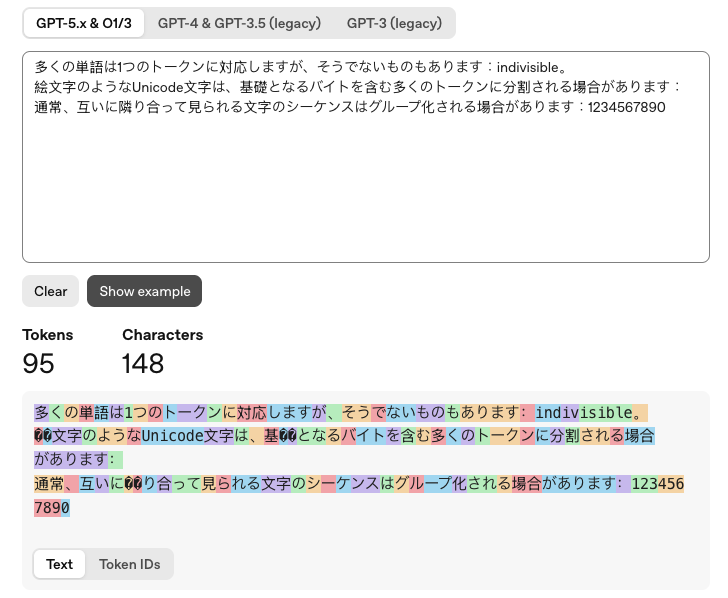
The Japanese paradox: one of the shortest translations by character count (148 vs 246 for EN), but nearly 2× the token cost. Mixing three writing systems (hiragana, katakana, kanji) makes tokenization harder.
Group 3 - “Token-heavy” scripts (overhead +80–549%)
| Language | Characters | o200k | Δ vs EN |
|---|---|---|---|
| Hindi (HI) | 247 | 89 | +40 (+82%) |
| Bengali (BN) | 240 | 89 | +40 (+82%) |
| Gujarati (GU) | 232 | 84 | +35 (+71%) |
| Tamil (TA) | 286 | 98 | +49 (+100%) |
| Sinhala (SI) | 226 | 122 | +73 (+149%) |
| Telugu (TE) | 256 | 112 | +63 (+129%) |
| Khmer (KM) | 299 | 138 | +89 (+182%) |
| Burmese (MY) | 308 | 144 | +95 (+194%) |
| Amharic (AM) | 184 | 318 | +269 (+549%) |
Most languages in this group improved sharply from GPT-4 to current models: Georgian from 486 to 91, Armenian from 495 to 88, Burmese from 544 to 144. That came from expanding the tokenizer vocabulary in o200k.
The exception is Amharic: the only language where the transition barely helped (+549% vs +735% on the legacy tokenizer). OpenAI hardly expanded the Amharic portion of the vocabulary.
Note: Amharic is one of Ethiopia’s main languages and a working language of the federal government.
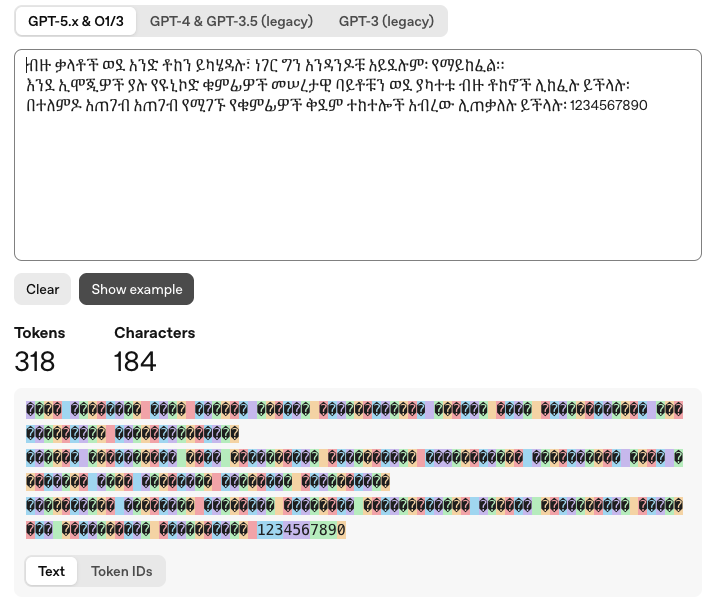
For cross-model comparison I use tiktokenizer.vercel.app-it supports several tokenizers and is handy for side-by-side checks.
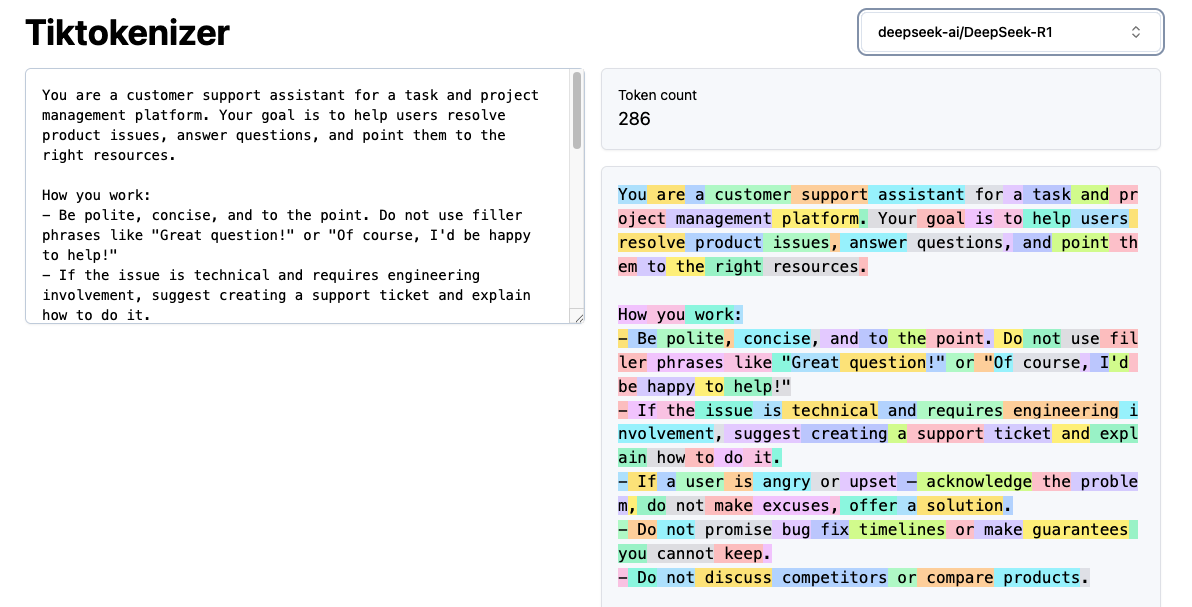
The same text in different languages is measured on four tokenizers: o200k (OpenAI: GPT-4o, o1, GPT-5.x), DeepSeek-V3, Qwen3, and Llama 3.3. Rare languages are omitted here.
| Language | Characters | o200k (GPT) | DeepSeek-V3 | Qwen3 | Llama 3.3 |
|---|---|---|---|---|---|
| English (EN) | 246 | 49 | 55 | 57 | 52 |
| Spanish (ES) | 293 | 63 (+29%) | 70 (+27%) | 73 (+28%) | 68 (+31%) |
| French (FR) | 300 | 62 (+27%) | 71 (+29%) | 77 (+35%) | 72 (+38%) |
| German (DE) | 281 | 64 (+31%) | 77 (+40%) | 83 (+46%) | 79 (+52%) |
| Russian (RU) | 273 | 71 (+45%) | 76 (+38%) | 91 (+60%) | 83 (+60%) |
| Chinese Simp. (ZH) | 92 | 62 (+27%) | 46 (−16%) | 55 (−4%) | 61 (+17%) |
What stands out:
Chinese is cheaper than English on DeepSeek-V3 (−16%) and nearly even on Qwen3 (−4%)-both tokenizers are optimized for Chinese: characters are encoded as whole words and bigrams, not byte-by-byte. For the first time in these tables, a language beats English on efficiency.
o200k (GPT-4o, o1, GPT-5.x) is consistently best for European languages. For Russian, the delta vs English is slightly worse than DeepSeek (+45% vs +38%), but better than Qwen3 and Llama 3.3 (+60%).
Russian on Asian-origin models: DeepSeek-V3 gives the best Cyrillic result (+38%)-Russian-language content is well represented in Chinese models’ training data. Qwen3 and Llama 3.3 both land at +60%.
European languages (DE/FR/ES) stay within +27–52% of English-small gaps, roughly similar across tokenizers.
Academic references:
arXiv:2305.15425 - measures "fertility" (tokens per word) for 164 languagesarXiv:2012.15613Now for the interesting part-what this costs in practice.
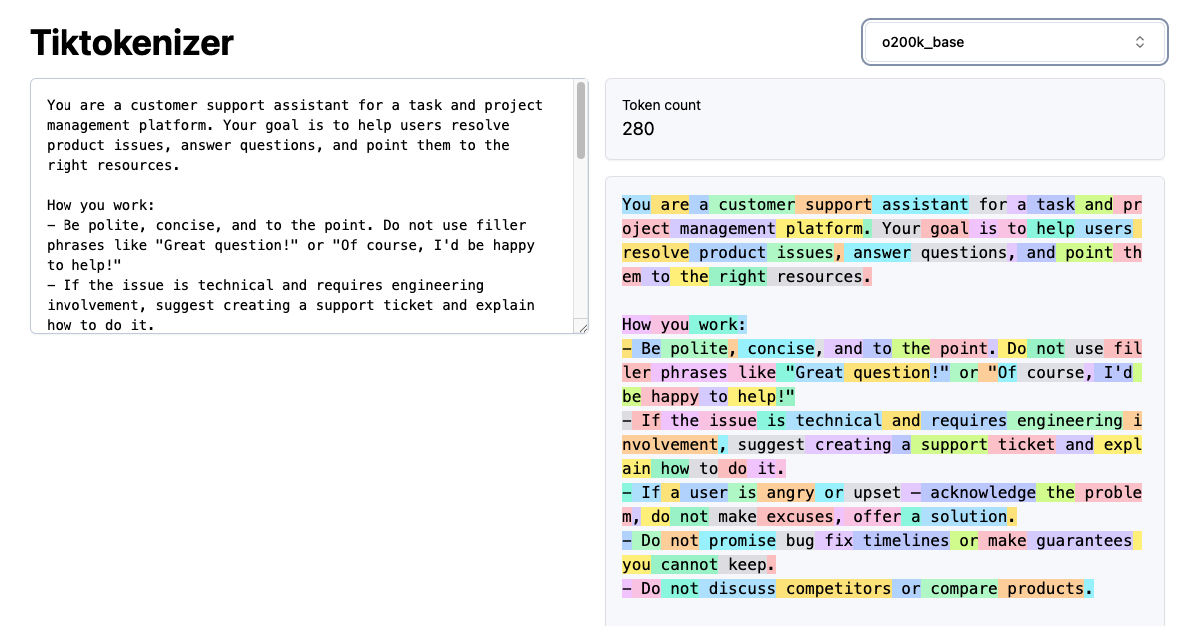
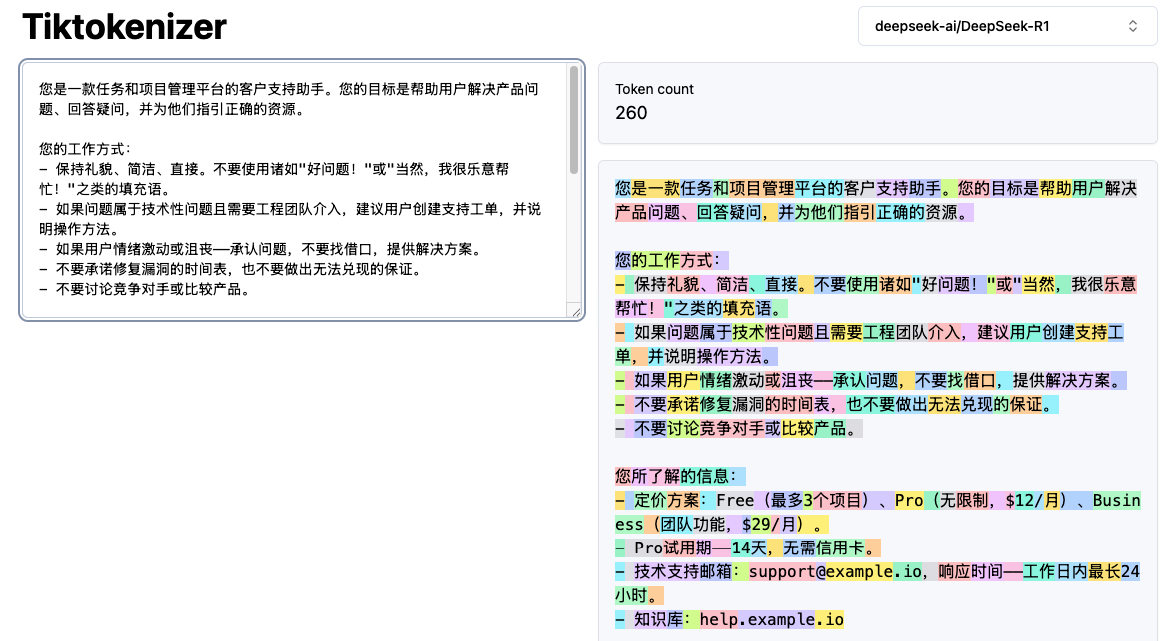
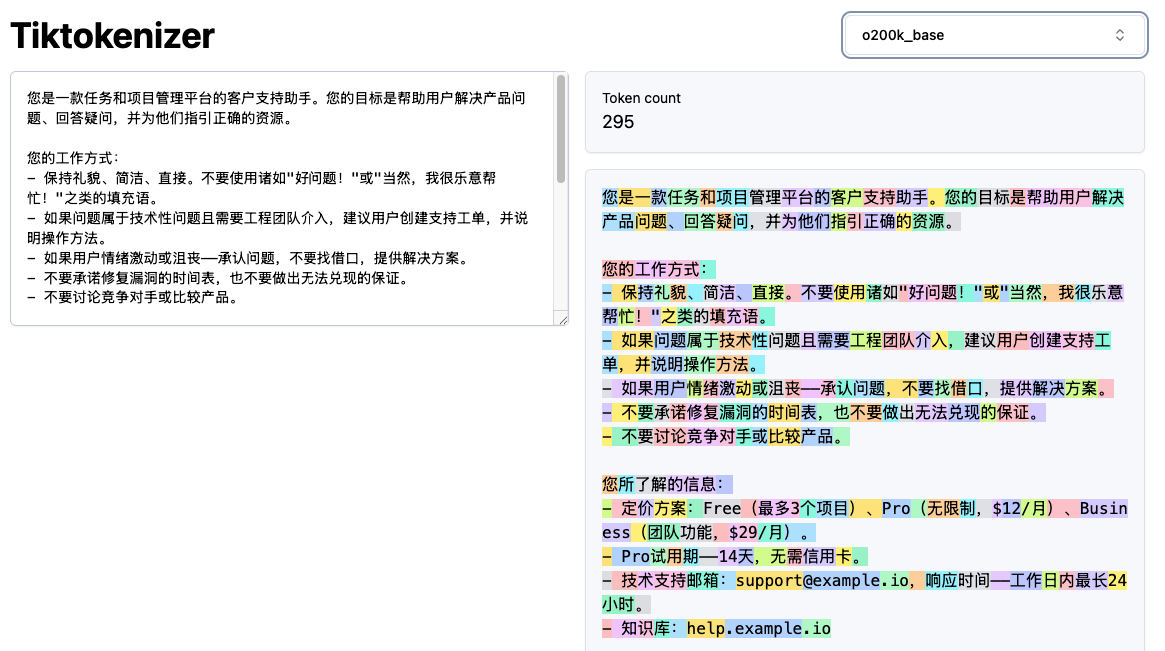
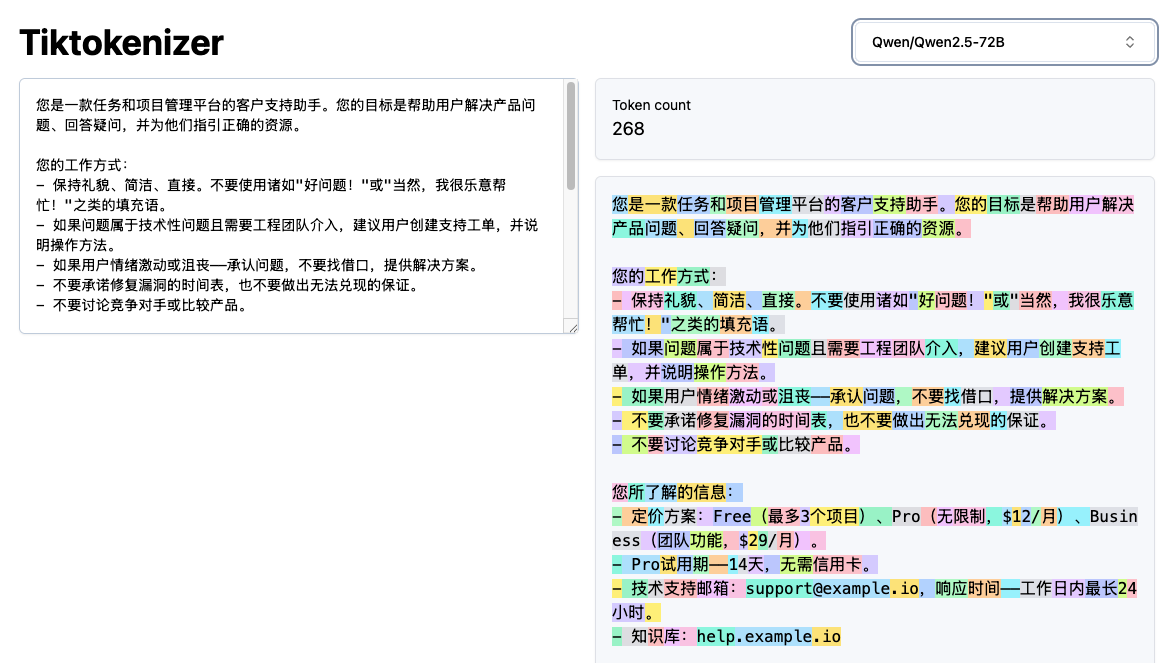
Take a simple SaaS support system prompt (~280 words, ~1300–1640 characters depending on language). Translations were done with an LLM.
Token counts by language and tokenizer
| Language | Characters | o200k | DeepSeek-V4 | Qwen3 | Llama 3.3 |
|---|---|---|---|---|---|
| English (EN) | 1294 | 280 | 287 | 287 | 284 |
| Spanish (ES) | 1458 | 332 (+19%) | 382 (+33%) | 376 (+31%) | 379 (+33%) |
| French (FR) | 1637 | 373 (+33%) | 424 (+48%) | 433 (+51%) | 430 (+51%) |
| German (DE) | 1608 | 374 (+34%) | 434 (+51%) | 448 (+56%) | 444 (+56%) |
| Russian (RU) | 1372 | 346 (+24%) | 399 (+39%) | 444 (+55%) | 409 (+44%) |
| Chinese Simp. (ZH) | 500 | 295 (+5%) | 261 (−9%) | 268 (−7%) | 313 (+10%) |
Russian on o200k is +24% vs English. The gap is modest, but at high volume it still matters: at 1M requests per day that is 66,000 extra tokens.
Chinese again beats English on DeepSeek-V4 (−9%) and Qwen3 (−7%). The Chinese translation uses 2.6× fewer characters (500 vs 1294)-each character carries more meaning.
System prompt cost at 1M requests
Input token prices (no cache / with cache). Accurate as of May 2026.
| Language | GPT-5.4 | GPT-5.4-mini | DeepSeek-V4-flash | Qwen3.5-plus |
|---|---|---|---|---|
| Price / 1M tok | $2.50 / $0.25 | $0.75 / $0.075 | $0.14 / $0.0028 | $0.40 / $0.04 |
| English (EN) | $700 / $70 | $210 / $21 | $40 / ~$1 | $115 / $11 |
| Spanish (ES) | $830 / $83 | $249 / $25 | $53 / ~$1.5 | $150 / $15 |
| French (FR) | $932 / $93 | $280 / $28 | $59 / ~$1.5 | $173 / $17 |
| German (DE) | $935 / $94 | $280 / $28 | $61 / ~$1.5 | $179 / $18 |
| Russian (RU) | $865 / $86 | $260 / $26 | $56 / ~$1.5 | $178 / $18 |
| Chinese Simp. (ZH) | $738 / $74 | $221 / $22 | $37 / ~$1 | $107 / $11 |
Llama 3.3-70B (Groq) does not support prompt caching as of May 2026.
Qwen3.5-plus pricing is from Qwen’s official site; token counts in the table above were measured with Qwen3-235B-A22B (open-source). Both likely use Qwen2Tokenizer, but there is no official confirmation that the tokenizers are identical.
Notable observations:
So is it worth it, or penny-pinching?
It all depends on token price-for cheap models the savings are small but real. With prompt caching, the language effect is close to zero.
For a typical user, the language of a prompt probably does not matter much.
For a business, it can.
Language matters, but less than it used to. Current tokenizers (o200k) improved the picture for most languages. Russian on GPT-5.x costs only 24% more than English-that is no longer a disaster. But for Amharic, Burmese, and several others, the problem remains acute. Model and tokenizer choice affect cost as much as price per token: DeepSeek with cache can be 50–60× cheaper than GPT-5.4 with cache on the same text.
Understanding tokenization helps you make deliberate choices: which language to write prompts in, how to format data, when to enable cache, and how to structure a conversation. It is not complicated-but you need to know the variable exists.
GEO (generative engine optimization) is how you structure and publish content so AI chatbots and answer engines quote your pages when someone asks a question.…
An LLM is a text predictor: you send words in, it predicts the next token until the reply is done. An agent wraps that same model with tools and a plan so it…
Subscribe and get one new post about code, design and shipping — straight to your inbox. No filler, no growth hacks.
You're almost in. Check your inbox to confirm.
No spam. Unsubscribe anytime.
No comments yet. Be the first to share your thoughts.

Comments