
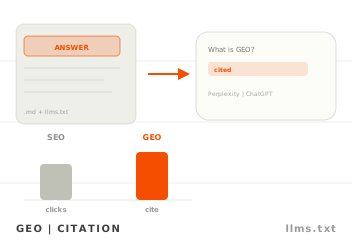
GEO for developers: what gets cited by ChatGPT and Perplexity
GEO (generative engine optimization) is how you structure and publish content so AI chatbots and answer engines quote your pages when someone asks a question.…
BLOG
Product updates, engineering deep dives and notes from the field — written by people who actually ship the code.
Subscribe and get one new post about code, design and shipping — straight to your inbox. No filler, no growth hacks.
You're almost in. Check your inbox to confirm.
No spam. Unsubscribe anytime.
AI FOUNDATIONS
Free Anthropic Academy courses on Skilljar: Claude 101, API, MCP, and Code tracks. Who each fits, time estimates, learning paths, and FAQ.
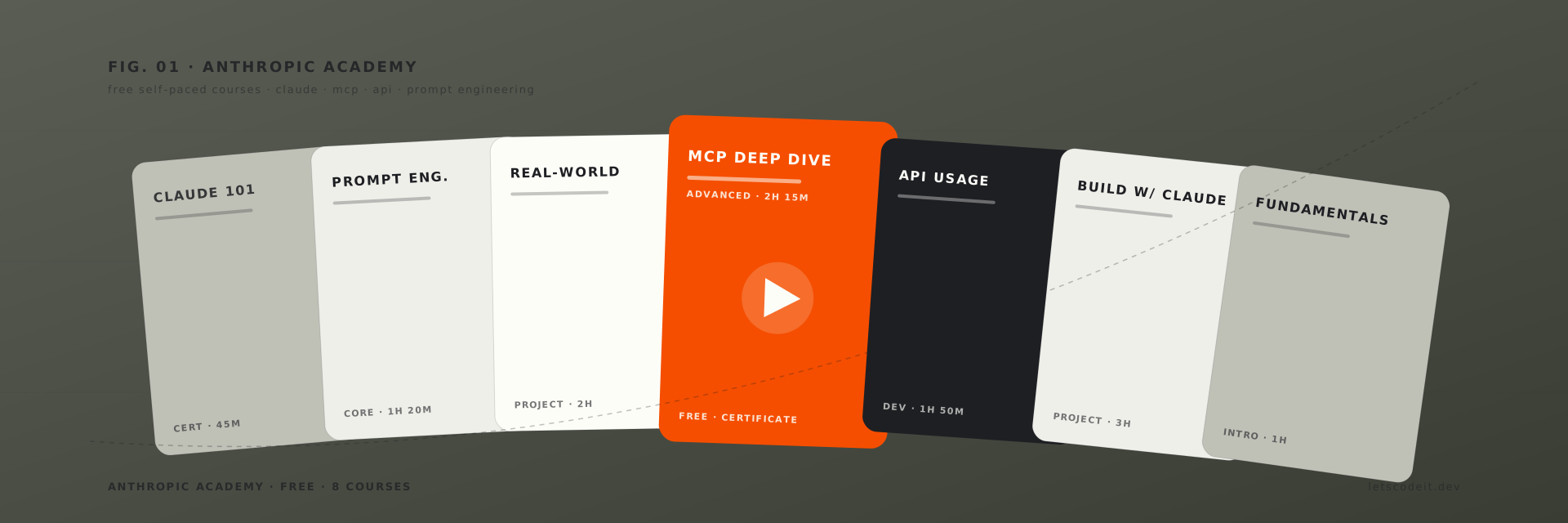
FIG. 01 ·AI Foundations — May 13, 2026
Anthropic Academy is Anthropic's free learning platform on Skilljar. As of June 2026, it hosts self-paced courses on Claude chat, the API, Claude Code, MCP, plus role-specific AI fluency tracks. You do not need a paid Claude subscription to enroll. Sign up, pick a course, and work through modules at your own pace.
The catalog splits into general-audience fluency courses, developer tracks (API, Code, MCP), audience-specific variants (students, educators, nonprofits), and cloud deployment courses for AWS and GCP.
| Track | Example courses | Typical time | Best for |
|---|---|---|---|
| Getting started | Claude 101, AI Fluency: Framework & Foundations | 30 min – 2 hr | Anyone new to Claude or AI collaboration |
| Developer core | Claude Code 101, Building with the Claude API | 1 – 3 hr | Engineers shipping with Claude |
| Integrations | Intro to MCP, MCP Advanced Topics, Agent Skills | 1 – 2 hr each | Teams extending Claude with tools and servers |
| Role-specific | AI Fluency for Students, Educators, Nonprofits | Varies | Tailored workflows, not generic tips |
If terms like RAG or embeddings are still fuzzy, skim the AI & LLM glossary before the API or MCP modules.
These courses assume no engineering background. Start here if you have never used Claude in daily work.
The on-ramp. Covers everyday Claude tasks and core product features, plus where to go next. If you have never opened Claude, begin here.
Best for: Complete beginners.
Time: ~30 minutes.
A structured take on collaborating with AI systems: mindset plus workflow, with a dedicated ethics module. Most vendor courses skip the ethics piece. This one does not.
Best for: Anyone who wants a repeatable approach to AI collaboration, not one-off prompts.
Time: ~1–2 hours.
Explains what modern AI is good at and where it fails, plus why that gap matters more than launch-day hype.
Best for: People separating realistic capabilities from marketing copy.
Developer tracks go deeper into Claude Code, the API, plus integration patterns. I finished Claude Code 101 and Building with the Claude API; certificates linked below.
Covers Claude Code in a daily dev workflow: setup and first tasks, then habits that stick. Taught by the team that built the tool.
Best for: Developers new to Claude Code.
Time: ~1 hour.
Builds on Claude Code 101 with real workflow integration: repos and code reviews on recurring tasks instead of one-off experiments.
Best for: Developers who tried Claude Code once and want it in their normal loop.
The deepest developer course on the platform. Walks from first API call through production-oriented patterns. Pair it with token economics basics if you are estimating cost before you ship.
Best for: Engineers building applications on Claude.
Time: ~2–3 hours.
Build MCP servers and clients in Python. Covers the three MCP primitives (tools, resources, prompts) for wiring Claude to external services.
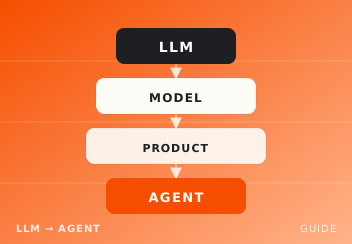
New to agents and tool use? Read the LLM and agent hierarchy guide first.
Best for: Developers building custom Claude integrations.
Time: ~1–2 hours.
Follow-up to the intro MCP course: sampling, notifications, filesystem access, plus transport choices for servers you would run outside a demo.
Best for: Developers who shipped a basic MCP server and need production patterns.
How to write and test Skills in Claude Code, then share them across repos: reusable markdown instructions Claude applies when the task matches.
Best for: Teams standardizing AI workflows across repos.
Using sub-agents in Claude Code to delegate work and isolate context so the main thread stays readable when tasks sprawl.
Best for: Power users hitting context limits on large codebases.
Anthropic repackages the same AI Fluency framework for different roles. Pick the variant that matches your job, not the generic track.
Hands-on Cowork workflows: task loops, plugins, file handling, research steps, plus steering multi-step work without losing the plot.
Best for: People who want productive Claude use in week one.
AI skills for coursework and career planning in academic settings.
Best for: University students.
For faculty and instructional designers applying AI in teaching and institutional planning.
Best for: Teachers and academic administrators.
For instructors who run AI fluency programs and need assessment patterns, not just slide decks.
Best for: Professors and trainers running AI courses.
Mission-aligned AI use for nonprofit teams: impact without drifting from organizational values.
Best for: Nonprofit staff and leaders.
Same fluency framework, reframed for owners and small teams without dedicated AI staff.
Best for: Small business operators.
These courses target teams deploying Claude through a hyperscaler, not the consumer chat product.
Built for an AWS accreditation program. Covers Claude on Amazon Bedrock. Originally internal to AWS; now public on Academy.
Best for: Teams already standardized on AWS.
Parallel track for Google Cloud's Vertex AI deployment path.
Best for: Teams on GCP.
Three paths cover most readers. Adjust if you already know Claude basics.
Developer new to AI:
Building integrations:
Team adoption:
Most AI training still sits behind paywalls or scattered YouTube playlists. Anthropic Academy is different in three ways: it is free with no upsell, content comes from the Claude team, and courses follow clear progressions instead of random tips. The range runs from "what is AI" through production MCP patterns.
These courses will not turn you into a research scientist. They will give you skills you can use this week, which is what most practitioners actually need.
Yes. Anthropic Academy courses on Skilljar are free to enroll and complete. You do not need a paid Claude subscription. Create a Skilljar account, open a course, and work through modules at your own pace. Some courses issue completion certificates you can share publicly.
As of June 2026, the catalog includes Claude 101, AI Fluency tracks (general, students, educators, nonprofits, small business), Claude Code courses, API development, MCP intro and advanced modules, Agent Skills, Subagents, Claude Cowork, and cloud deployment courses for Amazon Bedrock and Google Vertex AI.
Non-developers should start with Claude 101, then AI Fluency: Framework & Foundations. Developers should add Claude Code 101 and Building with the Claude API after those two. Integration work follows with Introduction to Model Context Protocol, then the advanced MCP and Agent Skills courses.
Most individual courses run 30 minutes to three hours. Claude 101 is about 30 minutes. Building with the Claude API is roughly two to three hours. Full learning paths that chain four courses typically take a focused weekend, not a semester.
GEO (generative engine optimization) is how you structure and publish content so AI chatbots and answer engines quote your pages when someone asks a question.…
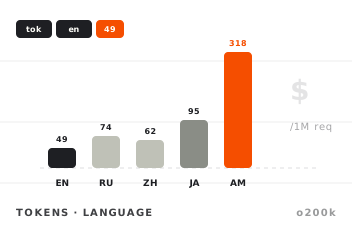
When you send a message to an LLM, you are not paying for characters or words. You pay for tokens . A token is the unit the model splits text into before…
Subscribe and get one new post about code, design and shipping — straight to your inbox. No filler, no growth hacks.
You're almost in. Check your inbox to confirm.
No spam. Unsubscribe anytime.
No comments yet. Be the first to share your thoughts.
Comments